Melanie DePriester
Staff Writer
AI feels like a topic that you just can’t escape from. It’s something that has already affected a bunch of job markets and will only continue to advance and creep its way into even more industries. Whenever you’re thinking of or talking about the future, it’s a subject that always finds its way into conversation.
Personally, I don’t have a gripe with turning to AI when it’s for simple things, like spelling mistakes, brainstorming ideas or figuring out how to add neon text to a website. But when it comes down to tasks that require a single ounce of creativity, this is where I draw the line and think that people shouldn’t rely on AI to do their entire workload for them. And especially not to make slop, like the Fruit Love Island TikToks.
There comes a point when it is essential to take a break and pause to think about whether what you are doing is right and how we can use AI not as a workforce but rather as a tool that can help aid people in their work.
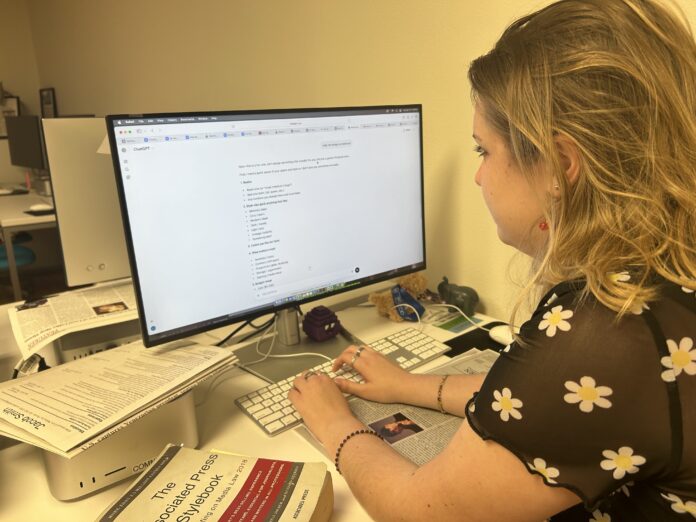
Take this article, for example. The Google Doc I’m currently working on is using AI to underline every mistake being made and is helping the overall piece be legible and easier to understand. Without AI, it would take a lot more work for myself and my editor to get this article to match the standards of publication for The Southern. Thanks to AI, I’m able to dedicate my time to figuring out the talking points of my article and how it’s organized instead of making sure everything is spelled correctly and every piece of punctuation is in its right place.
AI is also so much more than a grammar corrector, as it can be used as a helpful tool for helping with the more menial and tedious tasks. Chatbots such as ChatGPT provide instant support, answering common questions and guiding users efficiently. Additionally, there are data entry automation tools such as Zapier or Microsoft Power that minimize human error and save time by seamlessly transferring information between applications, allowing employees to focus on more strategic work.
AI does not just help improve work environments, it can also help with at-home or creative tasks. You can ask it how to best layout and decorate a room, what sort of recipes you can make with random ingredients in your fridge, what shirt goes with a specific pair of pants, etc. There are so many uses for AI where it helps enhance the creative process, rather than just replacing it entirely.
While many people are scared of losing their jobs to AI, it has become increasingly common in creative fields. Instead of fearing possible job displacement, it is essential to recognize the value that AI can bring to the table.
Knowing how to use AI effectively can significantly set you apart from other potential candidates. It demonstrates adaptability and a willingness to embrace new technologies, which are highly valued traits in any industry. AI can learn to perform certain tasks, allowing for increased efficiency that opens up opportunities for roles that require human insight and creativity to be focused on, rather than working on repetitive tasks.
AI will only continue to grow and become capable of more and more complex tasks. But rather than viewing it as a threat, I think it’s important that we learn how to use AI to our advantage. It should be viewed as a tool to improve your work, not outright replace it. For those that do choose to embrace AI, they will only be better because of it, as they will have proven that they can adapt and thrive under new conditions, instead of crumpling underneath them.