Frank Lloyd Wright, widely regarded as America’s most famous and greatest architect of the 20th century, left an indelible mark on Florida Southern College (FSC) in Lakeland, Florida. The campus is home to the world’s largest single-site collection of his buildings—13 structures in total—known collectively as the “Child of the Sun” campus.
This architectural legacy is now fully revealed in an unprecedented exhibition at the Ashley Gibson Barnett Art Museum. The exhibit finally allows Wright’s complete vision for the campus to be truly understood, showcasing his dream of a modern college bathed in the Florida sun, with designs that reflect the state’s landscape and citrus heritage.
FSC’s relationship with Wright began in 1938 when President Dr. Ludd Spivey telegrammed the architect, asking him to design a “campus of tomorrow.” Spivey wanted the school to be a reflection of modern technology and art.
Wright, a leader in “organic architecture,” embraced the concept. After surveying the site, which was covered in citrus trees, he explained his vision: the campus would grow “out of the ground and into the light – a Child of the Sun.” Thirteen of his designs were brought to life, including the iconic Annie Pfeiffer Chapel, Danforth Chapel, the Water Dome, and Polk Science building.
A signature element of Wright’s design is the Esplanade, a system of covered walkways stretching over a mile that connects all his buildings. These walkways were designed to visually mimic the orange tree groves that once covered the landscape. The architect also envisioned a Usonian-style neighborhood for the college, a concept for affordable, community-focused housing built from locally sourced materials, which was never constructed.
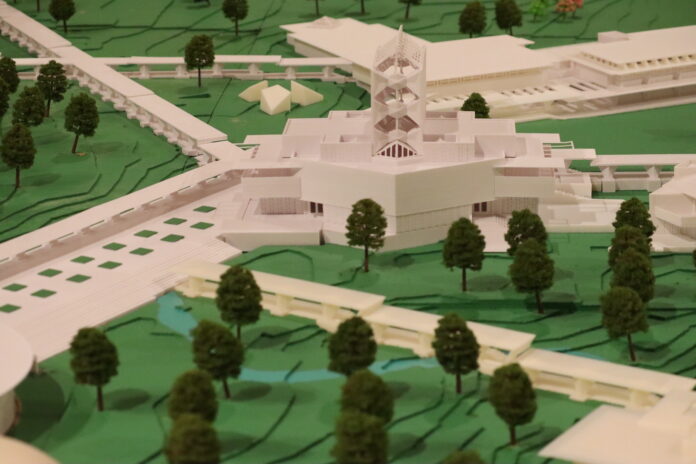
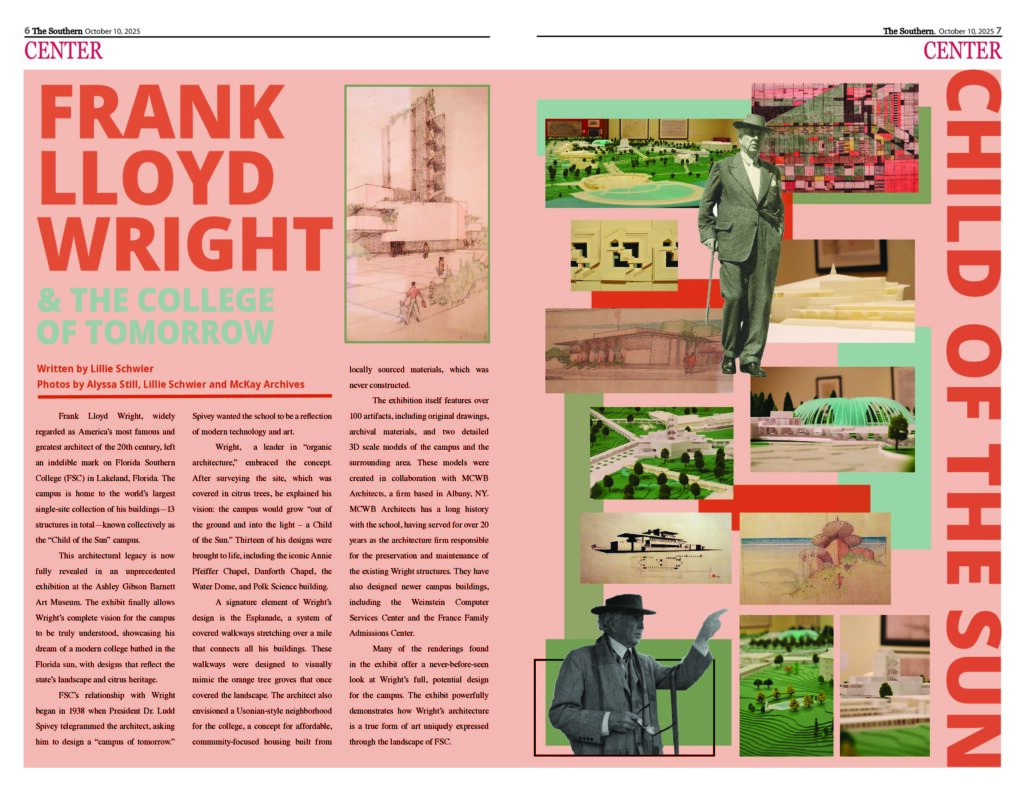
The exhibition itself features over 100 artifacts, including original drawings, archival materials, and two detailed 3D scale models of the campus and the surrounding area. These models were created in collaboration with MCWB Architects, a firm based in Albany, NY. MCWB Architects has a long history with the school, having served for over 20 years as the architecture firm responsible for the preservation and maintenance of the existing Wright structures. They have also designed newer campus buildings, including the Weinstein Computer Services Center and the France Family Admissions Center.
Many of the renderings found in the exhibit offer a never-before-seen look at Wright’s full, potential design for the campus. The exhibit powerfully demonstrates how Wright’s architecture is a true form of art uniquely expressed through the landscape of FSC.