Lillie Schwier
Southern Editor
I was probably seven years old when my family first began camping in our 1965 Shasta camper. It was fully restored, complete with a small loft, two silver wings, and a red stripe stretching across both sides. For a family of four, it became our way of exploring a version of Florida that most people never see.
Every long weekend, my family of four packed up and drove somewhere new across the panhandle. We biked for miles through state parks, fished under abandoned train bridges, and kayaked down rivers that felt untouched by time.
We didn’t grow up in a cul-de-sac, but on four acres next to cows. My favorite book wasn’t Harry Potter, but A Land Remembered, a story of generations who carved a life out of Florida’s rugged landscape. That story shaped how I saw this state wild and deeply rooted in something older than what most people recognize today, something that doesn’t quite belong to us.
Art was always a part of my life too. My grandfather was a painter, my grandmother as well, and my mom carried that same love with her. Our home was filled with paintings, some theirs, some from artists we met along the way.
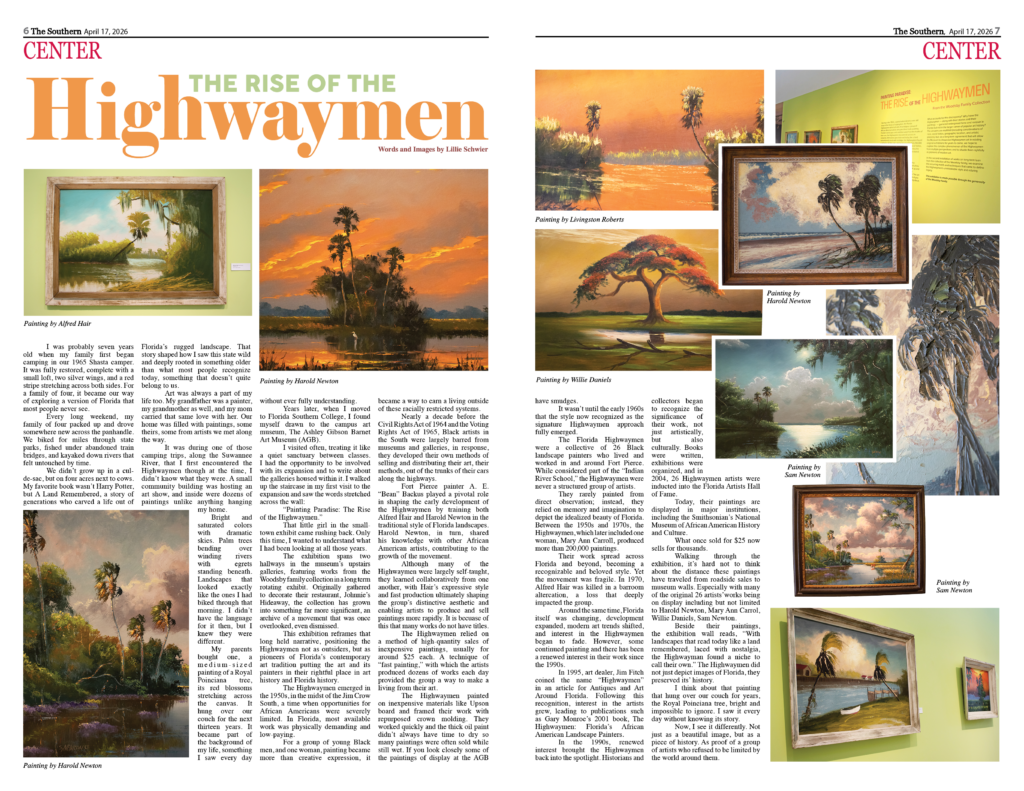
It was during one of those camping trips, along the Suwannee River, that I first encountered the Highwaymen though at the time, I didn’t know what they were. A small community building was hosting an art show, and inside were dozens of paintings unlike anything hanging my home.
Bright and saturated colors with dramatic skies. Palm trees bending over winding rivers with egrets standing beneath. Landscapes that looked exactly like the ones I had biked through that morning. I didn’t have the language for it then, but I knew they were different.
My parents bought one, a medium-sized painting of a Royal Poinciana tree, its red blossoms stretching across the canvas. It hung over our couch for the next thirteen years. It became part of the background of my life, something I saw every day without ever fully understanding.
Years later, when I moved to Florida Southern College, I found myself drawn to the campus art museum, The Ashley Gibson Barnet Art Museum (AGB).
I visited often, treating it like a quiet sanctuary between classes. I had the opportunity to be involved with its expansion and to write about the galleries housed within it. I walked up the staircase in my first visit to the expansion and saw the words stretched across the wall:
“Painting Paradise: The Rise of the Highwaymen.”
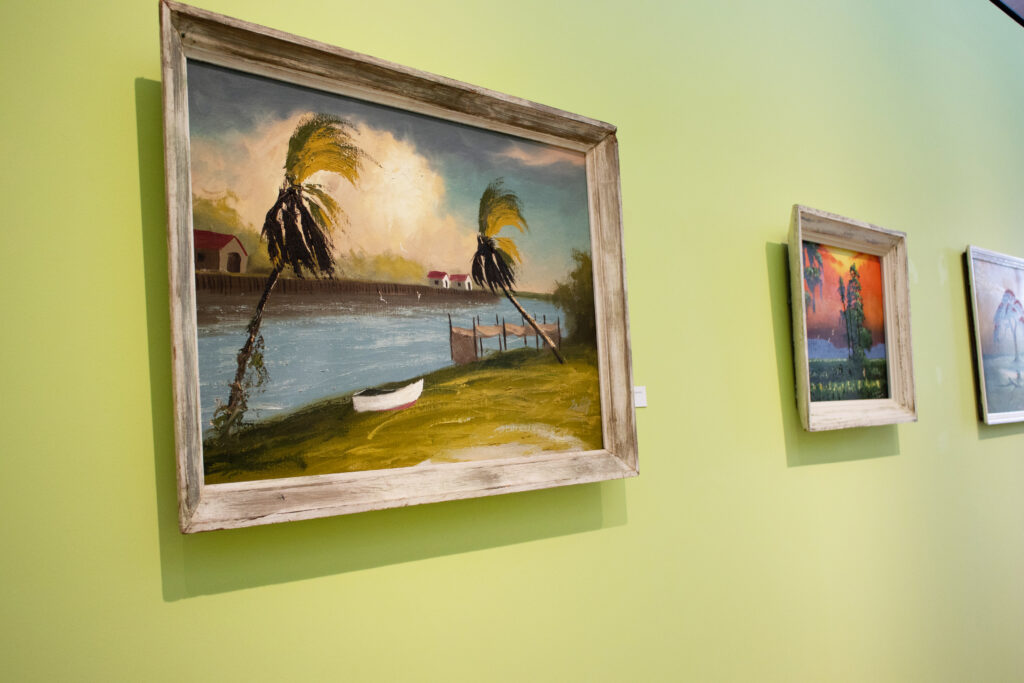
That little girl in the small-town exhibit came rushing back. Only this time, I wanted to understand what I had been looking at all those years.
The exhibition spans two hallways in the museum’s upstairs galleries, featuring works from the Woodsby family collection in a long term rotating exhibit. Originally gathered to decorate their restaurant, Johnnie’s Hideaway, the collection has grown into something far more significant, an archive of a movement that was once overlooked, even dismissed.
This exhibition reframes that long held narrative, positioning the Highwaymen not as outsiders, but as pioneers of Florida’s contemporary art tradition putting the art and its painters in their rightful place in art history and Florida history.
The Highwaymen emerged in the 1950s, in the midst of the Jim Crow South, a time when opportunities for African Americans were severely limited. In Florida, most available work was physically demanding and low-paying.
For a group of young Black men, and one woman, painting became more than creative expression, it became a way to earn a living outside of these racially restricted systems.
Nearly a decade before the Civil Rights Act of 1964 and the Voting Rights Act of 1965, Black artists in the South were largely barred from museums and galleries, in response, they developed their own methods of selling and distributing their art, their methods, out of the trunks of their cars along the highways.
Fort Pierce painter A. E. “Bean” Backus played a pivotal role in shaping the early development of the Highwaymen by training both Alfred Hair and Harold Newton in the traditional style of Florida landscapes. Harold Newton, in turn, shared his knowledge with other African American artists, contributing to the growth of the movement.
Although many of the Highwaymen were largely self-taught, they learned collaboratively from one another, with Hair’s expressive style and fast production ultimately shaping the group’s distinctive aesthetic and enabling artists to produce and sell paintings more rapidly. It is becuase of this that many works do not have titles.
The Highwaymen relied on a method of high-quantity sales of inexpensive paintings, usually for around $25 each. A technique of “fast painting,” with which the artists produced dozens of works each day provided the group a way to make a living from their art.
The Highwaymen painted on inexpensive materials like Upson board and framed their work with repurposed crown molding. They worked quickly and the thick oil paint didn’t always have time to dry so many paintings were often sold while still wet. If you look closely some of the paintings of display at the AGB have smudges.
It wasn’t until the early 1960s that the style now recognized as the signature Highwaymen approach fully emerged.
The Florida Highwaymen were a collective of 26 Black landscape painters who lived and worked in and around Fort Pierce. While considered part of the “Indian River School,” the Highwaymen were never a structured group of artists.
They rarely painted from direct observation; instead, they relied on memory and imagination to depict the idealized beauty of Florida. Between the 1950s and 1970s, the Highwaymen, which later included one woman, Mary Ann Carroll, produced more than 200,000 paintings.
Their work spread across Florida and beyond, becoming a recognizable and beloved style. Yet the movement was fragile. In 1970, Alfred Hair was killed in a barroom altercation, a loss that deeply impacted the group.
Around the same time, Florida itself was changing, development expanded, modern art trends shifted, and interest in the Highwaymen began to fade. However, some continued painting and there has been a renewed interest in their work since the 1990s.
In 1995, art dealer, Jim Fitch coined the name “Highwaymen” in an article for Antiques and Art Around Florida. Following this recognition, interest in the artists grew, leading to publications such as Gary Monroe’s 2001 book, The Highwaymen: Florida’s African American Landscape Painters.
In the 1990s, renewed interest brought the Highwaymen back into the spotlight. Historians and collectors began to recognize the significance of their work, not just artistically, but also culturally. Books were written, exhibitions were organized, and in 2004, 26 Highwaymen artists were inducted into the Florida Artists Hall of Fame.
Today, their paintings are displayed in major institutions, including the Smithsonian’s National Museum of African American History and Culture.
What once sold for $25 now sells for thousands.
Walking through the exhibition, it’s hard not to think about the distance these paintings have traveled from roadside sales to museum walls. Especially with many of the original 26 artists’works being on display including but not limited to Harold Newton, Mary Ann Carrol, Willie Daniels, Sam Newton.
Beside their paintings, the exhibition wall reads, “With landscapes that read today like a land remembered, laced with nostalgia, the Highwayman found a niche to call their own.” The Highwaymen did not just depict images of Florida, they preserved its’ history.
I think about that painting that hung over our couch for years, the Royal Poinciana tree, bright and impossible to ignore. I saw it every day without knowing its story. Now, I see it differently. Not just as a beautiful image, but as a piece of history. As proof of a group of artists who refused to be limited by the world around them.