Erin Grant & Isabella Kostik
News Editor & Staff Writer
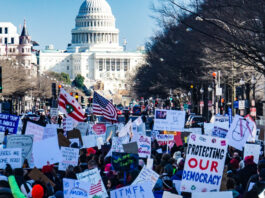
On Oct. 1, the United States entered into a government shutdown, bringing many federal operations to a standstill and reigniting debates about partisanship, spending priorities, and the future of American governance. As congress failed to pass necessary funding legislation by the deadline, thousands of federal workers were furloughed, and key services were temporarily halted. Despite multiple short-term funding measures, negotiations collapsed just before the fiscal year deadline.
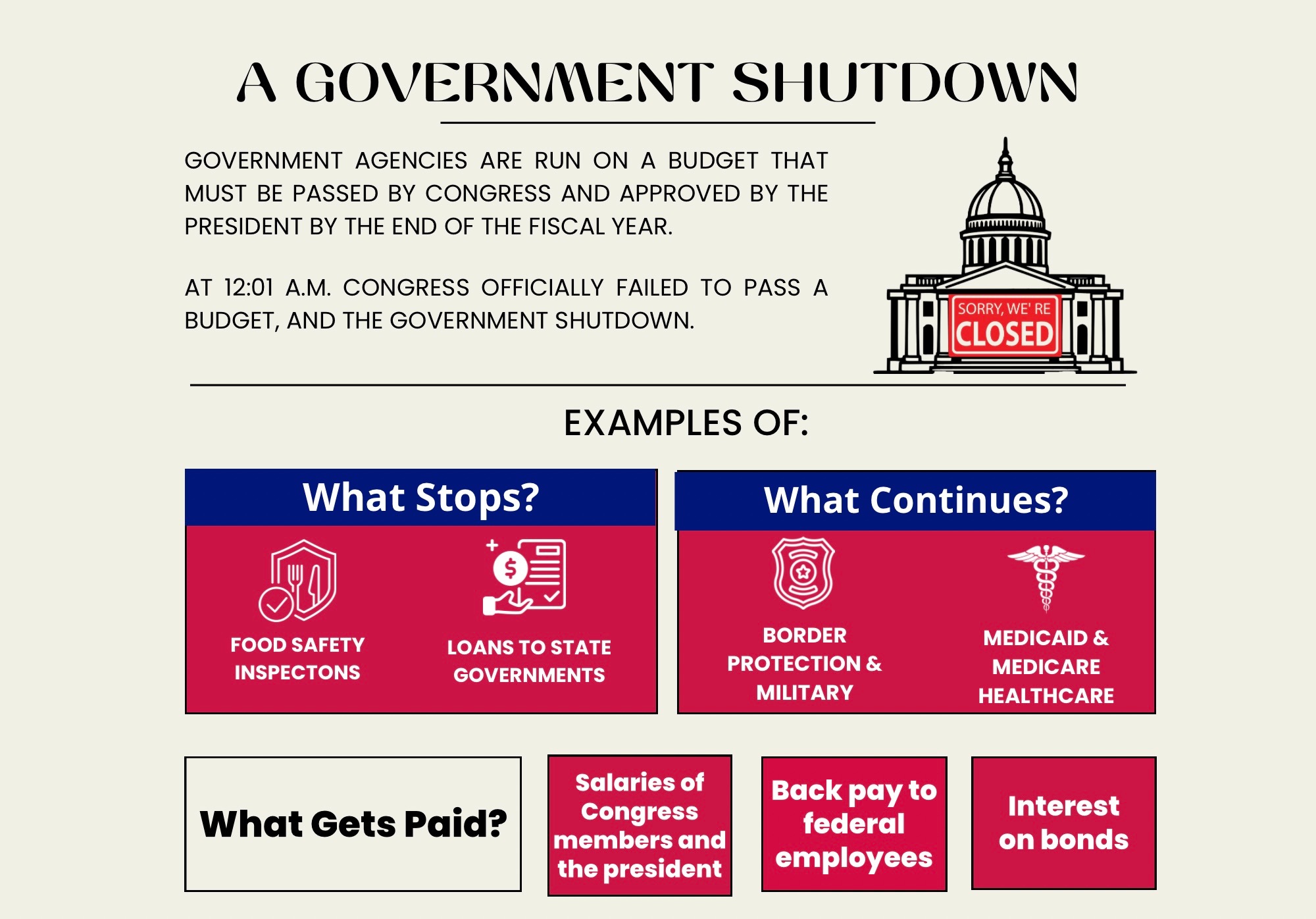
As a result, “non-essential” federal agencies, including parts of the National Park Service, IRS and several research departments, closed their doors. Many government employees were sent home without pay, while others, such as TSA and military personnel, continued working without immediate compensation. The shutdown also disrupted travel, slowed loan approvals, and caused delays in government benefits.
Economists warned that even a short shutdown could cost the US economy billions of dollars. Local businesses in your federal offices felt the strain, and public frustration grew over political gridlock. Students, travelers, and small business owners were among those most affected by delays in government services. The Congressional budget office estimated that the 2018-2019 government shutdown cost the United States economy $11 billion.
A government shutdown occurs when congress fails to pass legislation before the end of the Fiscal year on Sept. 30. This legislation, otherwise known as appropriation bills, sets aside money that funds the operations of all federal agencies and programs. The House of Representatives, often referred to as holding the “power of the purse,” plays a crucial role by initiating spending bills. Without an agreement from both chambers and the President’s signature, the government loses its authority to spend, leading to a shutdown.

The 2025 shutdown was largely driven by disagreements between Republicans and Democrats over whether to extend the federal subsidies that lower the monthly cost for health insurance for people who buy plans through the Affordable Care Act marketplaces. Democrats are pushing for a permanent continuation of these premium tax credits and reversal of the Trump administration’s cuts to medicaid programs, while the Republicans feel that healthcare subsidies should be negotiated separately at a later date.
If the credits are allowed to expire, a big impact on Americans can be expected According to PBS, more than 24 million people have Affordable Care Act health insurance, and if the credits expire, annual out-of-pocket premiums are estimated to increase by 114%.
Historically, the United States has seen several shutdowns since the modern congressional budgeting process began in 1976. Previous trends seemed to point to a decline in government shutdowns, 6 since 1990. Prior to the current government shutdown, the 2018-2019 shutdown was the longest government shutdown, ending at 35 days. On Wednesday, the current government shutdown became the longest in history.
The effects of the shutdown have also spread to college campuses. Students across the country are experiencing delays in financial aid processing, including FAFSA, Pell Grants, and federal loans. Many work-study and campus jobs supported by federal funds are on hold, and federal research programs are temporarily frozen.
Lawmakers are now under more pressure than ever to find a long-term solution to end the shutdown and rebuild public trust in government efficiency. The senate continues to vote on potential stopgap bills to reopen critical government agencies, but representatives in the house hold strong that healthcare subsidies are a concern for a later time. If Congress can agree on a continuing resolution, it would temporarily fund the government at existing levels, buying time to negotiate a full-year spending plan. However, if a compromise can’t be reached, the longest government shutdown in United States history will continue.
The 2025 government shutdown served as yet another reminder of how political division can disrupt daily life and economic stability. Whether the lessons learned will lead to meaningful reform or simply set the stage for future crises remains to be seen.