David Brady
Staff Writer
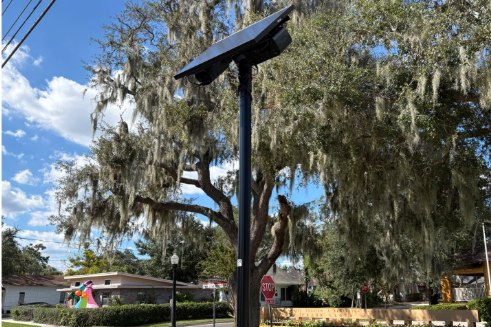
As FSC students rounded Lake Hollingsworth on their way to move-in for the academic year, they may have noticed camera fixtures that previously had gone unnoticed: Flock cameras. The solar-powered posts that host these cameras can be seen facing Lake Hollingsworth Drive next to the Becker Business Building and around Lake Hollingsworth near Collins Lane. Another near the intersection of Frank Lloyd Wright and Johnson Avenue stands without the camera itself.
These cameras became embroiled in controversy this summer as diverse critics like the ACLU and Gov. Ron DeSantis turned against what the governor called the beginning of a “surveillance state.” Law enforcement agencies making use of these automatic license plate readers’ (ALPRs) argue that the cameras are a vital tool for law enforcement to ensure public safety and catch criminals. For Florida Southern, the question is who controls these cameras and what they can see.
“We have no access to it at all,” Director of Safety and Security Eric Rauch said. “The access is through the Lakeland Police Department.”
The cameras can only be accessed by the Lakeland Police Department, which operates and pays for the ALPRs.
While every LPD officer has access, Sgt. Sean Finney told The Southern, “We’re not actively monitoring what’s going on near or around [campus] through the Flock cameras.”
The Electronic Frontier Foundation explains that ALPRs are high-speed automated cameras that grab all license plates and identifying information of all vehicles that pass in view of the typically mounted camera.
According to the New York Times, Flock contracts with 7,000 law enforcement agencies spread across all 50 states and over 100,000 cameras. Its databases collect the location and identifying details and use artificial intelligence to catalog those details for officers to search in a nationwide database. It automatically flags vehicles from the FBI’s database of stolen vehicles but can also be set up by officers to alert when other vehicles pass a camera.
High-profile instances of law enforcement abuse of these systems have raised concerns about their use across the country. In one such case, the New York Times reported, a Milwaukee police officer used Flock’s system to search his ex’s license plate 124 times. In another, a KING 5 news media investigation found that the Washington State Department of Licensing granted Border Patrol, ICE and Homeland Security access to their Flock data.
Under mounting public pressure, many cities have revoked their contracts with Flock. DeSantis ordered Flock systems to be removed from state roads in late August, but many city and municipal governments in Florida continue to make use of the cameras. Polk County Sheriff Grady Judd defended the use of Flock cameras in Polk County in a video posted to his office’s Facebook page as “the single best tool to keep people safe.”
In regard to the cases of misuse in other states, Finney argued that “every access point should have a case number attached” to track instances of abuse. He added, “We need to have the guardrails in place to hold them criminally liable, civilly punish them and make them lose their jobs, period.”
Finney pointed to at least one incident where a license plate reader attached to his patrol car aided in ensuring the safety of FSC students. Following reports of a man engaged in indecent exposure in front of female students, Finney was able to capture the man’s plate when he fled and find the man at his home, where Finney said he confessed to being on campus 10 to 12 times.
“In my time in law enforcement,” Rauch said, “every tool that’s come along for law enforcement has been somewhat misused at the beginning of its inception. And I think Flock, with proper guardrails, could be a great tool.”