The Southern Editor
The Southern newspaper, that is now housed in the Communication’s department, has a legacy that far predates the department’s creation, the Lakeland campus and even the very name Florida Southern College.
From 1901 to 1921, FSC – then called Southern College – was based in Sutherland, Florida. It was in 1918 that the student newspaper was founded under the leadership of President R.H. Alderman.
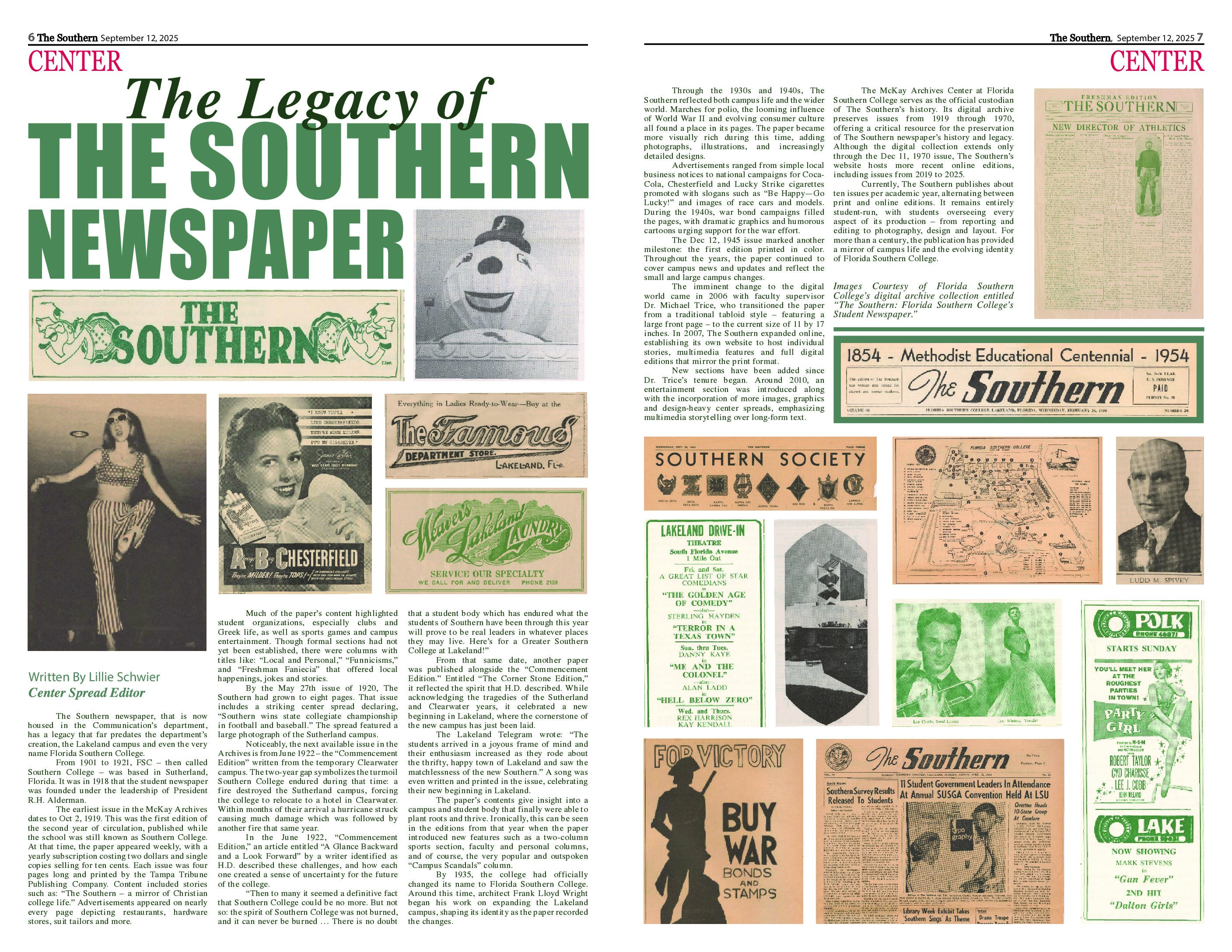
The earliest issue in the McKay Archives dates to Oct 2, 1919. This was the first edition of the second year of circulation, published while the school was still known as Southern College. At that time, the paper appeared weekly, with a yearly subscription costing two dollars and single copies selling for ten cents. Each issue was four pages long and printed by the Tampa Tribune Publishing Company. Content included stories such as: “The Southern – a mirror of Christian college life.” Advertisements appeared on nearly every page depicting restaurants, hardware stores, suit tailors and more.
Much of the paper’s content highlighted student organizations, especially clubs and Greek life, as well as sports games and campus entertainment. Though formal sections had not yet been established, there were columns with titles like: “Local and Personal,” “Funnicisms,” and “Freshman Faniecia” that offered local happenings, jokes and stories.
By the May 27th issue of 1920, The Southern had grown to eight pages. That issue includes a striking center spread declaring, “Southern wins state collegiate championship in football and baseball.” The spread featured a large photograph of the Sutherland campus.
Noticeably, the next available issue in the Archives is from June 1922 – the “Commencement Edition” written from the temporary Clearwater campus. The two-year gap symbolizes the turmoil Southern College endured during that time: a fire destroyed the Sutherland campus, forcing the college to relocate to a hotel in Clearwater. Within months of their arrival a hurricane struck causing much damage which was followed by another fire that same year.
In the June 1922, “Commencement Edition,” an article entitled “A Glance Backward and a Look Forward” by a writer identified as H.D. described these challenges, and how each one created a sense of uncertainty for the future of the college.
“Then to many it seemed a definitive fact that Southern College could be no more. But not so: the spirit of Southern College was not burned, and it can never be burned … There is no doubt that a student body which has endured what the students of Southern have been through this year will prove to be real leaders in whatever places they may live. Here’s for a Greater Southern College at Lakeland!”
From that same date, another paper was published alongside the “Commencement Edition.” Entitled “The Corner Stone Edition,” it reflected the spirit that H.D. described. While acknowledging the tragedies of the Sutherland and Clearwater years, it celebrated a new beginning in Lakeland, where the cornerstone of the new campus has just been laid.
The Lakeland Telegram wrote: “The students arrived in a joyous frame of mind and their enthusiasm increased as they rode about the thrifty, happy town of Lakeland and saw the matchlessness of the new Southern.” A song was even written and printed in the issue, celebrating their new beginning in Lakeland.
The paper’s contents give insight into a campus and student body that finally were able to plant roots and thrive. Ironically, this can be seen in the editions from that year when the paper introduced new features such as a two-column sports section, faculty and personal columns, and of course, the very popular and outspoken “Campus Scandals” column.
By 1935, the college had officially changed its name to Florida Southern College. Around this time, architect Frank Lloyd Wright began his work on expanding the Lakeland campus, shaping its identity as the paper recorded the changes.
Through the 1930s and 1940s, The Southern reflected both campus life and the wider world. Marches for polio, the looming influence of World War II and evolving consumer culture all found a place in its pages. The paper became more visually rich during this time, adding photographs, illustrations, and increasingly detailed designs.
Advertisements ranged from simple local business notices to national campaigns for Coca-Cola, Chesterfield and Lucky Strike cigarettes promoted with slogans such as “Be Happy—Go Lucky!” and images of race cars and models. During the 1940s, war bond campaigns filled the pages, with dramatic graphics and humorous cartoons urging support for the war effort.
The Dec 12, 1945 issue marked another milestone: the first edition printed in color. Throughout the years, the paper continued to cover campus news and updates and reflect the small and large campus changes.
The imminent change to the digital world came in 2006 with faculty supervisor Dr. Michael Trice, who transitioned the paper from a traditional tabloid style – featuring a large front page – to the current size of 11 by 17 inches. In 2007, The Southern expanded online, establishing its own website to host individual stories, multimedia features and full digital editions that mirror the print format.
New sections have been added since Dr. Trice’s tenure began. Around 2010, an entertainment section was introduced along with the incorporation of more images, graphics and design-heavy center spreads, emphasizing multimedia storytelling over long-form text.
The McKay Archives Center at Florida Southern College serves as the official custodian of The Southern’s history. Its digital archive preserves issues from 1919 through 1970, offering a critical resource for the preservation of The Southern newspaper’s history and legacy. Although the digital collection extends only through the Dec 11, 1970 issue, The Southern’s website hosts more recent online editions, including issues from 2019 to 2025.
Currently, The Southern publishes about ten issues per academic year, alternating between print and online editions. It remains entirely student-run, with students overseeing every aspect of its production – from reporting and editing to photography, design and layout. For more than a century, the publication has provided a mirror of campus life and the evolving identity of Florida Southern College.
Images Courtesy of Florida Southern College’s digital archive collection entitled “The Southern: Florida Southern College’s Student Newspaper.”